- All
- Product Name
- Product Keyword
- Product Model
- Product Summary
- Product Description
- Multi Field Search

Views: 0 Author: Site Editor Publish Time: 2026-05-08 Origin: Site


Miscalculating a shipping container's weight isn't just a simple logistical oversight. It causes severe downstream issues immediately. These issues range from heavy Federal DOT axle fines to delayed ocean freight. You might even face dropped crane loads and compromised building foundations. Many buyers rely on generic estimates for their projects. This habit leads to serious logistical failures. It compromises site foundations and creates unsafe transport configurations. Understanding exact baseline weights matters deeply for your project's success. Legal payload limitations dictate exactly how you can move your goods. In this guide, we move past basic guesswork to give you accurate data. We provide buyers and logistics planners with exact baseline weights. You will learn the strict legal payload limitations. We also reveal the structural realities of modifying your unit. Finally, we show you how to place a container safely.
*Insert a quick-reference Markdown table immediately for Featured Snippet capture:* Include Tare Weight for 10ft (~2,900 lbs), 20ft standard (~4,520 lbs), 40ft standard (~8,270 lbs), and 40ft High Cube (~8,600 lbs).
**Compliance Warning:** The physical capacity of a container is rarely the legal road limit; US highway GVW limits dictate actual transportable weight.
**Safety Imperative:** Ocean freight requires a Verified Gross Mass (VGM) submission per 2016 IMO regulations to prevent maritime accidents.
**Site Reality:** A fully loaded 40ft container exerts massive pressure exclusively on its four corner castings, requiring engineered ground preparation.
Quick Reference: Standard Empty Container Weights | ||
Container Size & Type | Estimated Tare Weight (lbs) | Estimated Tare Weight (kg) |
|---|---|---|
10ft Standard | ~2,900 lbs | ~1,315 kg |
20ft Standard | ~4,520 lbs | ~2,050 kg |
40ft Standard | ~8,270 lbs | ~3,750 kg |
40ft High Cube | ~8,600 lbs | ~3,900 kg |
You must evaluate physical footprint versus actual weight before planning any project. Bare empty weight varies significantly. Industry professionals call this the tare weight. The size and functional type dictate this number directly.
Standard and High Cube units show distinct weight differences. A 20ft standard unit weighs roughly 2,050 kg (4,520 lbs). A standard 40ft unit weighs about 3,750 kg (8,270 lbs). However, buyers often prefer 40ft High Cube units for extra vertical space. The added steel for this extra foot of height adds weight. A High Cube typically weighs around 3,900 kg (8,600 lbs). This extra 330 lbs changes your transport calculations.
Specialty containers require entirely different math. Refrigerated units, known as Reefers, weigh significantly more. A 20ft Reefer weighs about 3,080 kg (6,790 lbs). It features heavy insulation and built-in cooling equipment. This extra equipment directly reduces your available payload capacity. You must account for this lost capacity when shipping dense goods.
Manufacturing nuances also play a major role today. Newer units often utilize high-tensile corrugated steel. This advanced material offers incredible strength. Therefore, a modern unit from a tier-one shipping container manufacturer might weigh slightly less than a 15-year-old retired unit. Yet, they maintain identical structural integrity. Always consider the age and build material when estimating weight.
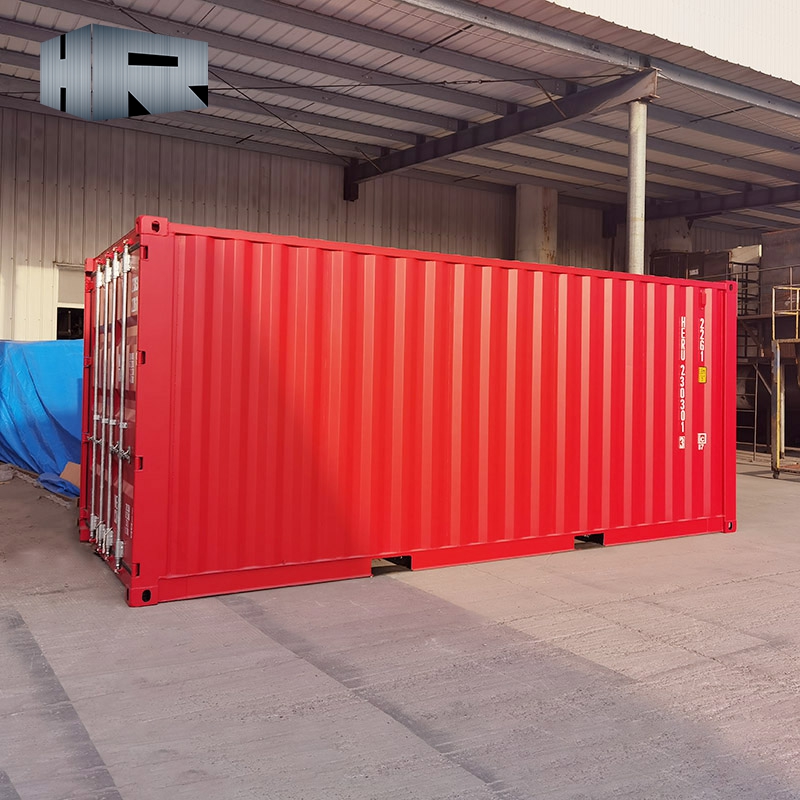
Every buyer must learn industry-standard terminology. Understanding these three critical metrics prevents severe logistical failures. You cannot rely on visual size alone.
First, you need to know the Tare Weight. We often call this the unladen weight. It simply represents the empty weight of the box itself. Second, you must understand the Max Gross Weight. This metric represents the absolute ISO-rated maximum limit. It includes the container plus your cargo inside. This maximum limit typically hits 67,200 lbs for both 20ft and 40ft standard units. Because both share this limit, 20ft units boast a superior payload-to-size ratio. They are the ideal choice for transporting dense, heavy goods. Finally, you calculate the Payload Capacity. This represents your net weight limit. You find it by subtracting the Tare Weight from the Max Gross Weight.
You never have to guess these numbers. You can verify them easily in person. Instruct your team to locate the Convention for Safe Containers plate. We call it the CSC plate. You will find it riveted to the left-hand door of the unit. This metal plate provides exact, certified ratings. It lists the verified tare weight. It also details the allowable stacking weight. Always trust the CSC plate over generic internet estimates.
Clean the CSC plate carefully if you buy a used unit. Rust often obscures critical numbers.
Never exceed the allowable stacking weight listed on the plate.
Update your logistics software using exact CSC numbers, not standard averages.
We often see buyers fall into a dangerous implementation trap. We call it the 80,000-lb GVW trap. Just because your unit can hold 60,000 lbs of payload safely does not mean it is legally transportable. US highway limits dictate actual real-world operations.
Road transport math requires strict attention. The Federal Gross Vehicle Weight (GVW) limit caps at 80,000 lbs. You must break this down to find your real cargo allowance. First, a standard semi-truck weighs about 18,000 lbs. Next, the chassis weighs roughly 8,000 lbs. Then, a 20ft empty box adds about 4,500 lbs. When you subtract these numbers, your actual legal cargo allowance drops significantly. You are typically left with a payload closer to 45,000 or 49,000 lbs.
The axle distribution factor causes the most legal trouble. Most overweight citations happen due to poor weight distribution. They violate the Federal Bridge Formula, not the overall GVW limit. You must pack your goods carefully. Less-than-Container Load (LCL) and Full Container Load (FCL) packing strategies must account for even weight dispersion. Heavy items must sit evenly across the floor space.
Ocean compliance follows an entirely different set of rules. The maritime industry enforces strict safety protocols. The 2016 IMO SOLAS requirement mandates a Verified Gross Mass (VGM) submission. You cannot load a vessel without it. Accurate weighing prevents dangerous port rejection. It stops costly logistics delays. Most importantly, it prevents dangerous ship imbalances at sea.
Weigh the fully loaded unit using calibrated chassis scales or ground scales.
Alternatively, use certified crane telemetry during the lifting process.
Submit the VGM paperwork to the carrier before the port cutoff deadline.
Ensure the signed VGM document matches your bill of lading exactly.
Custom builds create a massive blind spot for buyers. They convert units for storage, offices, or living spaces. However, they forget to calculate the added weight of materials. You must address this risk mitigation immediately.
Transparent assumptions help you estimate modification weights. We can break down typical add-ons to give you a clear picture. Wood framing and spray foam insulation add between 500 and 1,000 lbs. Installing drywall, flooring, HVAC systems, and electrical wiring adds substantial mass. A fully outfitted 20ft unit gains roughly 1,500 to 3,000 lbs from these finishes. Adding commercial roll-up doors and heavy steel reinforcements adds another 200 to 400 lbs.
Estimated Weight Additions for Container Modifications | ||
Modification Category | Materials Included | Estimated Weight Added (lbs) |
|---|---|---|
Framing & Insulation | Timber/steel studs, closed-cell foam | +500 to +1,000 |
Full Interior Build-Out | Drywall, floors, HVAC, electrical | +1,500 to +3,000 |
Custom Access | Roll-up doors, personnel doors, steel frames | +200 to +400 |
Exterior Upgrades | Roof pitch kits, exterior cladding | +800 to +1,500 |
Modifications trigger a dangerous center of gravity shift. Lifting modified units becomes a major pain point. Heavy interior installations shift the center of gravity drastically. For example, placing a heavy bathroom and kitchen on one side unbalances the unit. Riggers and crane operators must have accurate center of gravity data. They use this data to configure their lifting slings properly. Without it, they risk severe tilting. This imbalance can lead to catastrophic drops during delivery.
Failing to document the weight of every installed component.
Placing all heavy appliances on one end of the floor plan.
Cutting load-bearing corrugated walls without welding steel reinforcement frames.
Foundation failure represents a massive implementation risk. You must understand the physics of a loaded unit. A steel box does not distribute weight evenly across its entire flat bottom. The structural strength lies exclusively in the vertical corner posts. It relies on the heavy-duty corner castings.
Ground pressure metrics reveal a surprising reality. A fully loaded 40ft unit exerts massive pressure. It focuses thousands of pounds purely on its four tiny corners. This calculates to roughly 210 lbs per square foot of overall footprint impact. However, the corners themselves endure extreme localized pressure. If the ground is soft, these corners will sink deeply into the earth.
This sinking causes the dreaded "Stuck Door" phenomenon. People place heavy units on unlevel ground. They leave them on soft dirt without concrete pads. They ignore gravel bases or railroad ties. As a result, the frame experiences minor torsional twisting. This structural stress warps the door frame slightly. Instantly, the heavy steel cargo doors become incredibly difficult to open. Sometimes, they become completely impossible to move. Proper engineered ground preparation solves this problem permanently.
You need strong shortlisting logic before making a purchase. Approach your procurement based on strict weight realities. If you prioritize dense heavy machinery storage, buy a 20ft standard unit. It offers the absolute best payload density available. If you prioritize bulk volume over sheer weight, a 40ft High Cube is ideal. It maximizes your cubic footage perfectly.
Develop a clear sourcing strategy. We highly recommend purchasing from a specialized logistics provider. You can also source directly from a certified shipping container manufacturer. Reputable providers will supply exact CSC plate data upfront. They will provide the unit's structural history. They also guarantee compliant logistics handling from the start.
Your actionable takeaway is simple. Promptly consult with a professional provider today. Ask them to calculate accurate delivery weights for your specific site. Verify your property's site access capabilities. Ensure a truck can actually turn around on your land. Finally, arrange the appropriate drop-bed transport or crane-assisted delivery based on your final calculated weight.
Understanding container metrics is a vital exercise in risk management and legal compliance. It is never just a simple number.
Always align your payload calculations with strict road limits, not just the physical box capacity.
Require proper lifting techniques and accurate center of gravity data when moving modified units.
Invest in solid site foundations to guarantee smooth doors and structural integrity.
Following these rules guarantees a smooth deployment, whether for global export or a local ground-level office.
A: The ISO standard limits the Max Gross Weight for both 20ft and 40ft units to 67,200 lbs. Because a 20ft unit is half the size, its volume ratio allows for significantly denser packing. A 40ft unit fills up with volume long before it hits maximum weight, whereas a 20ft unit maximizes payload density.
A: A standard 20ft unit typically holds 10 standard US pallets. However, the volume constraint differs from the weight constraint. For very heavy goods like metal parts or liquids, you will hit the legal payload weight limits well before you fill all 10 pallet spaces.
A: Uneven ground causes minor torsional stress on the steel frame. Because a loaded unit exerts pressure only on its four corner castings, placing it on soft dirt or unlevel ground makes it sink unevenly. This twisting warps the door frame, causing the locking bars to jam.
A: You can find the exact empty (tare) weight on the Convention for Safe Containers (CSC) plate. This metal data plate is riveted to the outside of the left-hand cargo door. It lists the verified weight limits, manufacturing date, and stacking capacity.


