- All
- Product Name
- Product Keyword
- Product Model
- Product Summary
- Product Description
- Multi Field Search

Views: 0 Author: Site Editor Publish Time: 2026-05-13 Origin: Site


Fabricators and waste management businesses often research how to build a roll off dumpster. They usually want to explore DIY custom fabrication, such as specialized gooseneck models. They also use this foundational knowledge to vet commercial containers before making major capital purchases. A poorly constructed waste container inevitably causes serious operational issues. Floor warping, blown-out door hinges, and costly DOT compliance failures create massive risks on the highway. Recognizing these potential failure points matters deeply. High-quality construction keeps your fleet safe, compliant, and highly profitable. Building a commercial-grade container requires much more than a basic blueprint. It demands heavy-duty materials, precise CNC fabrication, and extensive structural reinforcements. Only specialized facilities typically possess these advanced capabilities. In this guide, you will learn the exact material specifications required. We will outline the six-step commercial manufacturing process thoroughly. You will also discover how to evaluate container quality and prepare deployment sites properly.
Structural Integrity is Key: The lifespan of a roll off dumpster relies heavily on floor finalization, gusset placement, and continuous welding.
Material Specs Matter: Standard commercial containers require heavy-gauge steel floors (often 7-gauge or 1/4-inch) and reinforced tubing to handle unpredictable debris weight.
Site & Deployment Realities: A well-built dumpster must be designed with staging in mind—requiring 60-foot truck approaches and specific ground load capacities.
DIY vs. Manufacturer: While blueprints exist, partnering with a dedicated roll off dumpster manufacturer usually yields a lower total cost of ownership when factoring in labor, equipment (CNC plasma/automated saws), and compliance.
We must outline fundamental dimensions first. You need exact connection types before cutting any metal. Standard models usually span 12 to 22 feet long. They stand anywhere from 3.5 to 8 feet tall. Capacities range from 10 to 40 cubic yards. You must finalize these blueprints early. Changing dimensions later wastes expensive raw steel. Engineers calculate payload distributions based on these initial frame blueprints.
Commercial trucks utilize different loading systems. Most standard models use a robust cable-pull mechanism. A heavy winch cable hooks to the front of the frame. This action pulls the container smoothly onto the chassis rails. Some operators prefer specialized gooseneck chassis connections. A gooseneck setup drastically changes how the trailer distributes weight. It shifts the payload closer to the truck cab. You see this request often in custom industry blueprints. It provides superior maneuverability for tight residential construction sites.
Material choice dictates the ultimate lifespan. Let us examine the essential structural components required for a commercial build.
Floor panels: You absolutely need heavy-gauge steel here. We recommend 1/4-inch or 7-gauge steel. This thickness remains non-negotiable for commercial builds. Floors handle extreme point loads daily. Dropped concrete and demolition debris will destroy thin metal quickly. Thick steel prevents severe buckling.
Wall thickness: Walls require a delicate engineering balance. You must weigh tare weight against long-term durability. Most builders use 10-gauge or 12-gauge steel plates. A 10-gauge wall effectively resists denting from heavy debris. A 12-gauge wall lightens the overall container. Lighter containers increase your legal payload capacity. You should match the wall gauge to your specific target industry.
Tubing and Rails: The main rails support everything above them. Manufacturers typically use 2-inch by 6-inch structural tubing. These heavy rails endure immense friction during ground loading. They must remain perfectly straight to ensure safe winching. Weak rails bend under maximum weight. Bent rails render the entire unit totally useless.
Best Practice: Always align your rail dimensions with standard hoist specifications. Mismatched rails cause dangerous loading scenarios and excessive equipment wear.
Standard Material Specifications Chart | |||
Component | Recommended Material | Primary Function | Common Failure Risk if Substandard |
|---|---|---|---|
Flooring | 1/4-inch or 7-gauge steel | Absorb impact from heavy debris | Severe buckling and tear-throughs |
Side Walls | 10-gauge or 12-gauge steel | Contain volume and resist side impact | Denting, bowing, and structural warping |
Main Rails | 2" x 6" structural tubing | Guide container onto truck chassis | Bending, binding during winch operations |
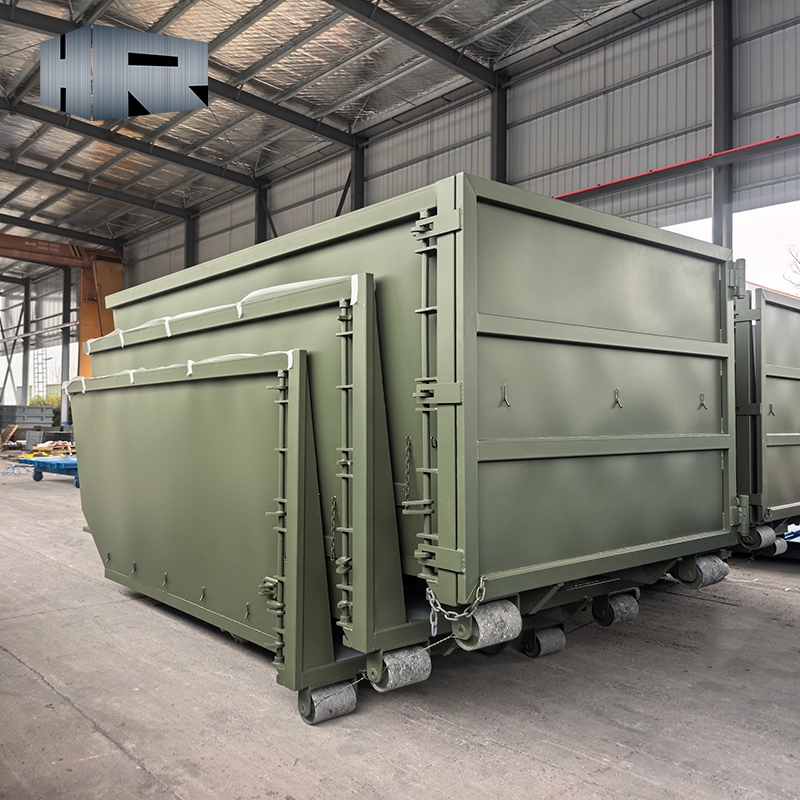
Building a dependable container requires strict adherence to industrial processes. We break down the fabrication journey into six distinct steps.
Step 1: Automated Tube Cutting & Frame Assembly
Heavy-duty automatic band saws start the process. They cut structural tubing perfectly square. This accuracy forms an incredibly strong foundational skeleton. Crooked cuts create weak, misaligned joints later. Welders assemble these precision-cut tubes in specialized jigs. This ensures perfectly parallel rails.
Step 2: Metal Sheet Crafting & CNC Plasma Cutting
Workers use CNC plasma technology next. This equipment cuts wall panels with extreme precision. It easily slices thick heavy-duty structural gussets. You can also cut custom company logos here. CNC machinery eliminates human error during metal crafting.
Step 3: Floor Finalization & Cross-Member Welding
This remains the most critical durability step. Welders space structural cross-members closely underneath the floor. They apply heavy welds across every joint. This robust framework prevents the floor from buckling. It easily handles intense point loads like dropped concrete or machinery.
Step 4: Door Welding & Hinge Reinforcement
Rear doors require serious mechanical engineering. Builders install heavy-duty hinges and secure cam latches. They add rigid structural framing around the door opening. This prevents catastrophic blowouts during highway transit. It ensures a tight, secure seal over thousands of uses.
Step 5: Precision Hand Welding
Experienced human welders step in for final assembly. They apply continuous welds on all high-stress seams. Stitch welds are totally unacceptable for commercial models. Continuous welding guarantees maximum structural strength. It also provides fully waterproof joints to prevent interior rusting.
Step 6: Protective Coating & Painting
The final step involves industrial surface preparation and painting. Technicians prime the bare steel surfaces thoroughly. They apply durable, high-gloss industrial paint. This barrier prevents rust and chemical corrosion. It withstands harsh outdoor elements year-round.
Common Mistake: Rushing the floor finalization process ruins containers. Skipping continuous welds on the cross-members guarantees premature floor failure under heavy loads.
Containers often reach weight limits before they reach volume limits. A well-built unit must handle high-density materials safely. Dirt, asphalt, and roofing shingles weigh significantly more than wood scraps. The chassis must never deform under these intense loads. We often see light-duty models fail spectacularly here. They fit the visual volume but buckle under the sheer weight.
Corner gussets indicate superior manufacturing craftsmanship. Builders weld these triangular steel plates directly into 90-degree corners. They reinforce critical structural stress points. You should always check the presence of these gussets. Inspect their placement and steel thickness. High-quality builds feature thick gussets at every major intersection.
Visual inspection reveals a lot about construction integrity. You must inspect welds for consistency and deep penetration. Look closely for a total lack of porosity. Good welds appear smooth, stacked, and uniform. Porous welds show tiny holes or surface bubbles. These physical defects weaken the joint significantly. They will inevitably crack under heavy stress.
Hardware standardization reduces your long-term maintenance costs. You should always insist on standard hardware. Wheels, hinges, and latches break eventually during rough usage. Using common sizes makes field replacement easy. Custom hardware leaves your container out of service for weeks. Standard parts keep your fleet moving smoothly. When sourcing a reliable roll off dumpster, standardized parts ensure maximum operational uptime.
Visual Quality Inspection Checklist | ||
Feature | Pass (High Quality) | Fail (Substandard) |
|---|---|---|
Welds | Continuous, smooth, deep penetration | Stitch welded, porous, bubbled |
Gussets | Present on all 90-degree corners | Missing or extremely thin metal |
Doors | Reinforced frames, heavy-duty hinges | Flimsy hinges, gaps when closed |
Hardware | Standardized, bolted/welded securely | Proprietary sizes, weak attachments |
DIY fabrication requires massive upfront capital. You need industrial press brakes and large CNC tables. Heavy-duty MIG welders and overhead cranes are strictly mandatory. Buying this equipment strains most business budgets quickly. The initial facility setup easily reaches hundreds of thousands of dollars.
Building one container in-house destroys unit economics. Fabricating a single unit takes weeks of intensive labor. Buying in volume changes the mathematical equation completely. A dedicated roll off dumpster manufacturer operates on massive scale. They purchase raw steel in huge bulk quantities. They streamline labor through efficient assembly line processes.
Highway safety risks carry massive liability. Uncertified custom builds lack rigorous safety testing. Factory-tested containers meet strict DOT regulations perfectly. An uncertified model might fail suddenly on the highway. This structural failure causes catastrophic accidents. Partnering with seasoned professionals eliminates this terrifying risk entirely.
Fleets scaling up need extreme predictability. You must evaluate manufacturers logically and carefully. Look closely at their weld quality and steel gauge transparency. Ask detailed questions about their standard production lead times. Building in-house rarely matches this high level of consistency. Sourcing a dependable roll off dumpster across various demanding industries requires trusted partners.
A perfectly built container is useless if undeliverable. You must plan for strict physical space requirements. Delivery trucks need a 60-foot straight approach line. They require at least 20 feet of vertical overhead clearance. Low trees and power lines often block deliveries. You must clear these obstacles beforehand.
Proper ground staging protects the underlying property. We strongly recommend using a 6-inch thick reinforced concrete pad. This easily handles the extreme truck and container weight. If placing on soft ground or grass, lay down 3/4-inch plywood. This strategy distributes the weight effectively across a wider area. It prevents severe sinking and extensive surface damage.
Extreme weather heavily impacts container placement. Freezing mud locks metal wheels firmly in place. Thawing ground turns solid yards into impassable swamps. You must consider these seasonal changes carefully. Place containers on high, well-drained ground. This strategic placement ensures rails and wheels perform optimally year-round.
Deployment Checklist:
Verify 60 feet of straight-line access.
Confirm 20 feet of vertical clearance.
Inspect ground density (use plywood for soft soil).
Check local weather forecasts for freezing or heavy rain.
Building a reliable container bridges raw heavy steel and precise engineering. You must respect the intense material requirements for long-term survival. Understanding the manufacturing process builds excellent fabrication knowledge. However, scaling a waste management business requires highly dependable assets. Volume-produced units offer unmatched reliability on job sites.
Take these actionable next steps today:
Request a technical spec sheet for your desired sizes.
Audit your current staging site for proper delivery clearances.
Schedule a consultation with a trusted manufacturing partner.
Compare your custom build capital requirements against factory-direct purchasing.
A: While basic plans exist in fabricator forums, commercial manufacturers utilize proprietary CAD designs to ensure weight distribution and DOT compliance. Relying on forum blueprints carries structural risks.
A: For heavy construction and demolition, 1/4-inch or 7-gauge steel is the industry standard to prevent warping. Thinner metals buckle under heavy point loads.
A: Delivery trucks typically require a 60-foot straight approach and 20 feet of overhead clearance to safely tilt and roll off the container.
A: Yes. Enclosures usually require an 8-foot high fence, a 15-foot wide gate, and a specialized 6-inch thick concrete pad to withstand the weight of the truck and container.


