- All
- Product Name
- Product Keyword
- Product Model
- Product Summary
- Product Description
- Multi Field Search

Views: 0 Author: Site Editor Publish Time: 2026-03-09 Origin: Site


Oversized cargo is difficult to load in standard shipping containers. They only open at the end, which limits access when moving long pipes, heavy machinery, or irregular equipment. This process often slows operations and increases labor risks.
A Side Open Container solves this issue by providing full-length access from the side. Workers can open the entire side wall, making it easier for forklifts and cranes to load large cargo efficiently.
In this guide, you will learn what a Side Open Container is, how it works, and why it offers advantages over traditional containers.
A Side Open Container is a specialized shipping container designed with full-length doors on one side. In addition to standard end doors, the entire side wall can open, allowing wide access to the container interior.
This design supports easier loading of long or oversized cargo. Materials such as steel beams, construction panels, or machinery can be placed directly inside without complex maneuvering.
Unlike flat rack or open-top containers, a Side Open Container remains fully enclosed. This means cargo stays protected from rain, dust, and theft during transport and storage.
The structure of a Side Open Container combines accessibility and durability. Manufacturers design the frame carefully so that the container remains strong even though one side opens fully.
Key design features include:
● Reinforced steel frame for structural stability
● Full-length folding side doors
● Heavy-duty hinges for large door movement
● Secure locking bars for transport safety
● Weather seals to prevent moisture entry
These features allow the container to maintain the same strength as traditional shipping containers.
The side doors of a Side Open Container operate through reinforced hinges and locking bars. Each door panel folds outward and can open up to 270 degrees. When fully opened, the entire side becomes accessible.
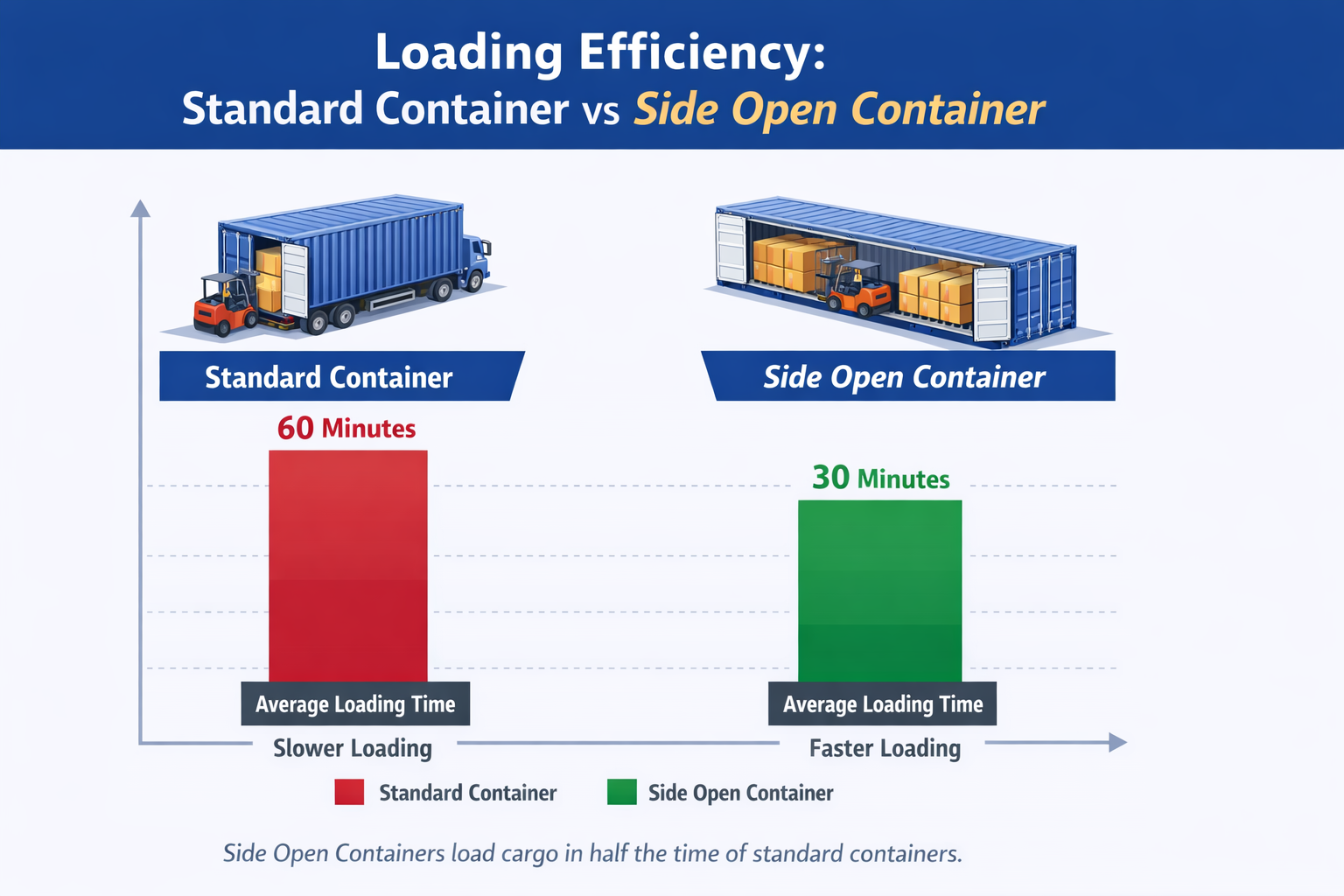
Forklifts can drive parallel to the container and place goods inside quickly. This reduces loading time compared with traditional containers.
Once loading is complete, the doors close and lock tightly against the steel frame. Locking bars ensure the container remains secure during shipping.
Traditional containers only have rear double doors. This design works well for palletized goods, but it limits loading flexibility.
A Side Open Container offers additional access points. Workers can load goods along the entire length rather than stacking cargo from the back.
Feature | Standard Container | Side Open Container |
Access points | End doors only | End + full side doors |
Loading method | Sequential loading | Side access loading |
Cargo type | Pallets and boxes | Oversized or long cargo |
Accessibility | Limited | Full-length access |
This difference significantly improves efficiency in industries handling large materials.
Different door configurations exist for a Side Open Container, depending on the design.
Common types include:
● Full side opening containers
● The entire side wall opens using multiple folding doors.One-post side opening containers
● A central post divides the side doors into two sections.Multi-door side containers
Several smaller doors open along the container length.Each configuration supports different loading methods and structural requirements.
Despite its open-side design, the Side Open Container remains highly secure. Strong locking bars run vertically along each door section. These bars engage with steel locking cams attached to the frame.
Additional protection includes:
● reinforced door hinges
● heavy-duty locking rods
● weather-resistant door seals
These features ensure cargo remains protected during shipping or storage.
A Side Open Container must maintain structural strength despite having a large opening. Manufacturers reinforce the steel frame using high-strength corner posts and cross beams.
Corrugated steel side panels increase rigidity while reducing overall weight. These panels also protect cargo from external impacts during handling.
Durability remains a core design goal. Containers must withstand lifting, stacking, and transport across ships, trucks, and rail systems.
Side doors form the most distinctive part of the Side Open Container. They consist of multiple folding panels connected with heavy-duty hinges.
The hinge system supports repeated opening without damaging the container structure. Most designs allow doors to fold flat against the exterior wall.
This layout keeps the loading area completely open.
A Side Open Container uses rubber gaskets and weatherproof seals along door edges. These seals prevent water, dust, and debris from entering the container.
Proper sealing is critical during ocean transport. Moisture can damage cargo such as machinery, textiles, or packaged goods.
Sealed doors maintain interior protection similar to standard containers.
Like all intermodal containers, a Side Open Container includes steel corner castings at each corner.
These castings allow cranes and lifting equipment to secure the container safely. Twist-lock systems connect containers during stacking on ships or trailers.
This design ensures compatibility with global shipping infrastructure.
Side-opening containers usually follow the same ISO size standards as conventional containers.
The 20-foot Side Open Container is suitable for smaller cargo shipments or on-site storage.
Typical dimensions include:
Specification | Measurement |
Length | 20 ft |
Width | 8 ft |
Height | 8.6 ft |
Internal volume | ~1,140 cubic ft |
This size is common on construction sites or warehouses requiring frequent access.
A 40-foot Side Open Container doubles the internal storage space compared with a 20-foot container.
It is often used for transporting long materials such as steel pipes or timber beams.
Specification | Measurement |
Length | 40 ft |
Width | 8 ft |
Height | 8.6 ft |
Internal volume | ~2,350 cubic ft |
High Cube containers offer an extra foot of vertical space. The Side Open Container High Cube model reaches 9.6 feet in height.
This additional space helps businesses store tall equipment or stack cargo more efficiently.
Cargo capacity depends on several factors:
● container dimensions
● maximum payload weight
● cargo distribution
Typical payload limits range from 26 to 28 metric tons (data requires verification).
Proper weight distribution prevents structural damage during transport.
Loading speed improves significantly with a Side Open Container. Workers can place goods along the entire container length.
Forklifts operate from the side rather than pushing pallets through a narrow doorway.
This reduces loading time and improves warehouse productivity.
Oversized items often cannot pass through standard container doors. Examples include:
● steel pipes
● timber beams
● construction scaffolding
● industrial machinery
A Side Open Container allows these materials to be loaded horizontally from the side.
Side access also improves storage efficiency. Workers can reach items anywhere in the container without unloading everything first.
This feature is particularly useful for tool storage, construction sites, and warehouse inventory.
The Side Open Container can serve many purposes beyond shipping.
Common adaptations include:
● temporary retail stores
● mobile workshops
● exhibition booths
● construction storage units
The wide side opening creates an instant workspace or display area.
Construction companies frequently rely on a Side Open Container to store and transport building materials. Long structural components such as steel beams, timber boards, pipes, and scaffolding can be placed directly inside through the side opening. This design eliminates the need to push heavy materials through narrow rear doors, which often slows down operations on construction sites.
Because forklifts and cranes can load materials from the side, workers can position cargo along the entire container length. This reduces loading time and helps construction teams organize materials more efficiently before transport.
Logistics providers use a Side Open Container when transporting oversized or irregular freight. Items such as industrial machines, equipment parts, and large packaged materials often require more flexible loading access. The side-opening design allows forklifts to move parallel to the container and place goods quickly inside.
This loading method improves workflow in warehouses and shipping yards. It also helps reduce cargo handling steps, which lowers the risk of product damage during loading and unloading.
In the retail and event industries, companies often convert a Side Open Container into a temporary shop or display space. When the full-length side doors open, the container creates a wide storefront area that can be used for product displays or customer interaction.
Businesses use these containers at trade shows, festivals, and outdoor markets because they are easy to transport and set up. The strong steel structure also allows for lighting, shelving, or branding installations.
Many companies use a Side Open Container as a temporary warehouse on construction sites or industrial facilities. The side access allows workers to quickly retrieve tools, spare parts, or equipment stored inside.
Unlike traditional containers, employees do not need to unload front cargo to reach items at the back. This saves time and helps maintain better organization for frequently used materials.
Standard shipping containers rely on rear doors for loading and unloading. Cargo must be placed sequentially from the back toward the front, which can slow operations when handling large shipments.
A Side Open Container provides full-length side access, allowing forklifts or cranes to place goods directly where needed. This reduces repositioning and allows multiple loading points along the container.
Cargo organization becomes easier with a Side Open Container because workers can see and reach items along the entire interior wall. Materials can be arranged by size or priority without stacking everything near the door.
In contrast, standard containers often become difficult to access once cargo fills the front area. Retrieving items in the middle may require unloading several pallets first.
Side loading reduces manual handling and equipment adjustments. Workers can position cargo faster and maintain better control during loading.
This efficiency helps reduce labor hours and improves workflow in busy warehouses or job sites where time and safety are critical factors.
A Side Open Container becomes the preferred option when cargo requires greater accessibility or flexible loading conditions. Businesses often choose it when materials are difficult to move through standard doors.
Choose a Side Open Container when cargo is:
● long or oversized
● frequently accessed
● difficult to load through standard doors
Standard containers remain practical for palletized goods or bulk shipments that do not require side access.
Tunnel containers feature doors at both ends of the container. This allows goods to pass through from one side to the other, which is useful for storage systems requiring front and rear access.
However, tunnel containers still lack full side openings. A Side Open Container offers wider entry space, which is better for loading wide cargo or equipment.
Open-top containers remove the roof panel to allow vertical loading by cranes. They are commonly used for heavy machinery, tall equipment, or bulk materials.
While open-top designs provide vertical access, they do not offer the same side accessibility as a Side Open Container, which makes side-loading operations more efficient.
Flat rack containers have no side walls and sometimes no roof. This design allows extremely large or irregular cargo to be transported, such as vehicles or industrial structures.
However, flat racks expose cargo to weather and environmental conditions. A Side Open Container provides similar loading flexibility while maintaining a fully enclosed structure for cargo protection.
Selecting the right container depends on operational needs and cargo characteristics. Businesses should evaluate several important factors before making a decision.
Key considerations include:
● cargo size and shape
● loading equipment available
● storage accessibility requirements
● transport method and distance
By analyzing these elements, companies can determine whether a Side Open Container or another specialized container type best fits their logistics or storage needs.
Standard containers limit loading access and slow the handling of oversized cargo in many logistics operations. A Side Open Container improves efficiency by allowing full-length side access for faster and safer cargo loading.
Hero equipment (Yangzhou) Co., LTD. provides durable Side Open Container solutions with strong structures and reliable performance, helping businesses improve transport efficiency and cargo accessibility.
A: A Side Open Container has full side doors, allowing easier loading of oversized cargo.
A: A Side Open Container opens along the side, while standard containers load only from the rear.
A: A Side Open Container improves loading speed and access for long or irregular goods.
A: A Side Open Container may cost more but reduces labor and handling time.
A: A Side Open Container works well for pipes, machinery, beams, and large equipment.
A: Yes, a Side Open Container allows quick access to stored tools and materials.


